
Utopai Studios launches PAI 2.0, its next-generation cinematic storytelling AI system
Utopai Studios has launched PAI 2.0, the latest version of its cinematic storytelling AI platform and a major step toward building infrastructure for AI-native filmmaking.


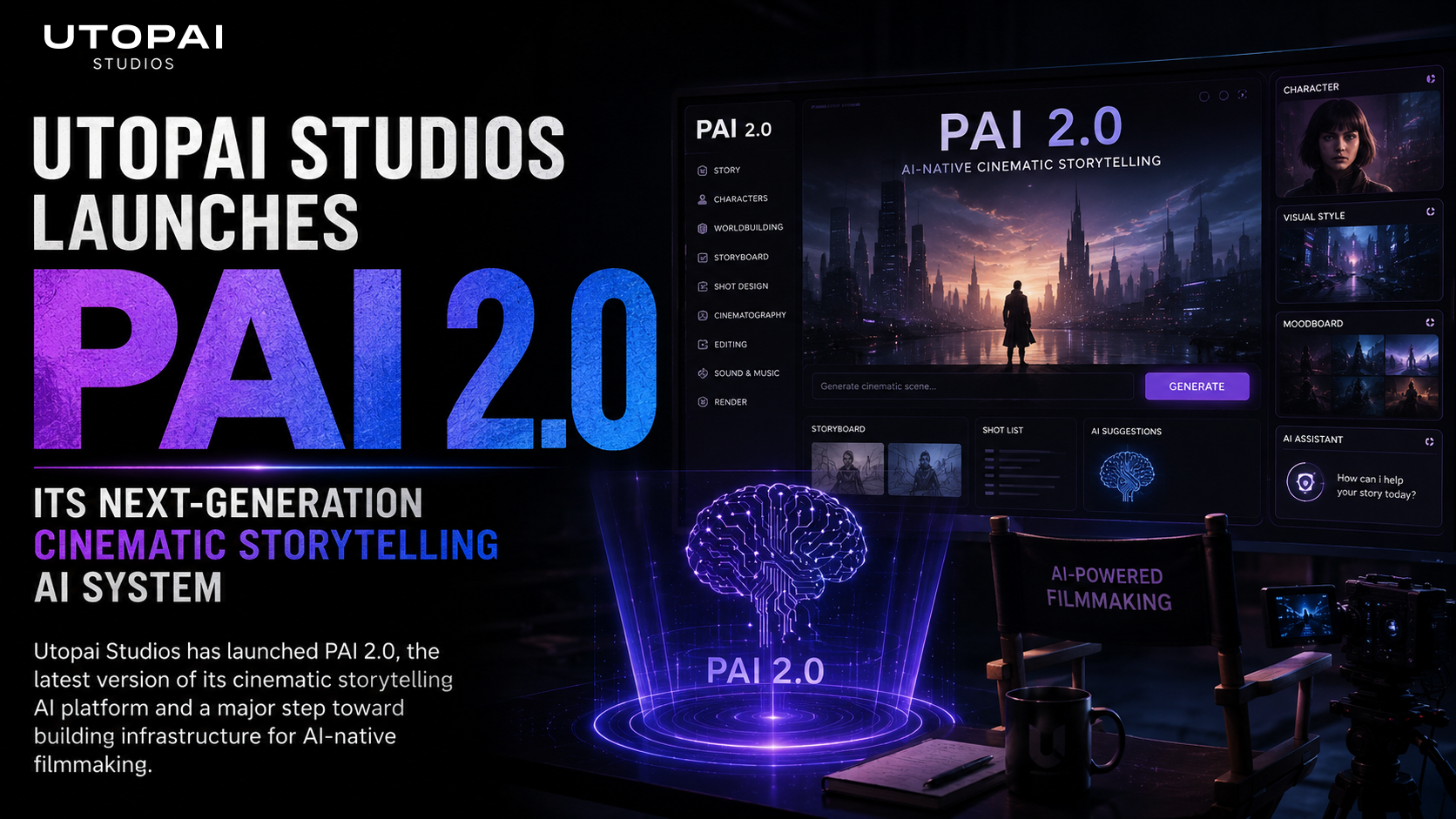
Utopai Studios has launched PAI 2.0, the latest version of its cinematic storytelling AI platform and a major step toward building infrastructure for AI-native filmmaking.
Released in less than two months after PAI’s debut, PAI 2.0 follows strong early adoption, with the platform reaching US$11 million in annual recurring revenue (ARR). The system is designed for creators, studios, production companies, and professional teams seeking greater creative control, consistency, and flexibility in video production.
PAI 2.0 is an agent-first cinematic creation platform that helps users plan, generate, and refine videos through personalised workflows. The platform combines a more advanced creative agent, a freeform canvas workspace, voice input, and upgraded image and video generation models, enabling users to manage story development, assets, storyboards, and video creation in a single environment.
“PAI 2.0 is designed to address the foundational challenges of long-form cinematic storytelling by preserving narrative context, maintaining consistency across extended sequences, and giving creators more granular control over the creative process,” said Utopai Studios chief scientific officer Zijian He.
Utopai Studios’s new PAI model redefines AI-assisted filmmaking process
Utopai Studios today announced a major update to its storytelling AI platform PAI, including an industry-first ability to render three-minute videos in 4K and a significant advancement to its story agent, designed to help filmmakers maintain continuity across shots, scenes, and edits.
From 15 April, the release marks a meaningful expansion of what filmmakers can do with AI across pre-production, production, and post-production. PAI is already being used in professional film and television productions in Hollywood, underscoring the platform’s growing role in long-form storytelling.
At the core of this release is PAI’s next-generation model, an important step forward in how filmmakers can manage visual narrative. Designed to help maintain continuity across characters, environments, and cinematography, it gives creative teams a more structured way to move from concept development to shot planning and revision, while supporting longer-form storytelling at greater scale.
“The next phase of AI in media will not be defined by isolated tools, but by systems that can carry story, continuity, and collaboration across the full creative process,” said Utopai Studios co-founder and CTO Jie Yang. “That is the direction we are building toward with PAI. The enhanced model is an important step toward giving filmmakers a more unified and practical way to develop, refine, and execute narrative work at a professional level.”
“Generative video is opening the door to a new production model, where creative ambition is less constrained by traditional cost and complexity,” said Utopai Studios co-founder and chief scientific officer Zijian He. “PAI is designed to help lead that shift by combining multimodal models and multi-turn editing in a way that gives creators more power to develop and execute sophisticated ideas with speed, control, and consistency.”
Built for creators at professional scale, PAI is designed to give filmmakers more control, predictability, and flexibility throughout the production process. Utopai Studios does not train its models on copyrighted materials, reflecting the company’s commitment to clean model data for creators, rights holders, and production partners.
Across professional workflows, PAI is being used in pre-production for rapid pre-visualisation, helping creative teams align on camera language, scene design, pacing, and tone. During production and post-production, PAI can be used to create complex or traditionally high-cost shots while also supporting repair, continuity adjustments, environment and object changes, lighting refinements, and localisation.
PAI model release is built on foundation with multi-shot sequencing, multi-turn editing, improved voice variety and character likeness, unlimited editing, simplified pricing, and new controls that give teams more flexibility across generation, editing, and asset management.
Discussion
No comments yet. Be the first to share your thoughts!