

Whistling Woods International Partners with InVideo to Launch AI Lab
Whistling Woods International (WWI), a film, communication, and creative arts institute in India, has announced a partnership with InVideo, an AI video platform, to establish the WWI-InVideo AI Lab at its campus in Mumbai’s Film City complex.


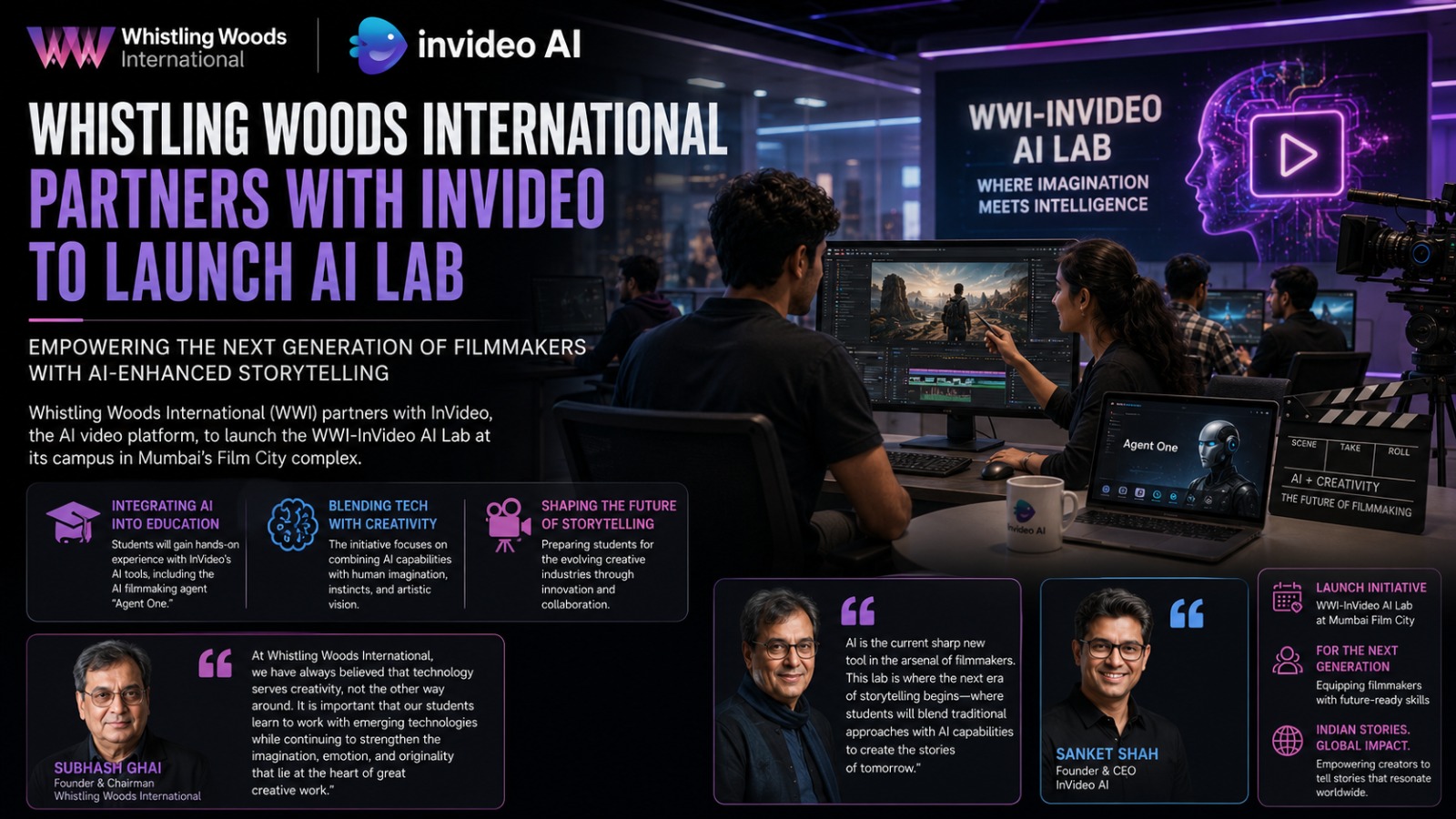
The collaboration aims to integrate AI-enhanced filmmaking tools into WWI’s curriculum. Students will gain access to InVideo’s technologies, including its AI filmmaking agent “Agent One,” as part of efforts to address the growing role of artificial intelligence in creative industries.
The partnership emphasizes combining AI tools with traditional creative skills. According to the institutions, the initiative highlights that technology can support new creative possibilities while human imagination, instincts, and artistic vision remain central to the craft.
Subhash Ghai, Founder and Chairman of Whistling Woods International, stated: “At Whistling Woods International, we have always believed that technology serves creativity, not the other way around. As the world evolves, it is important that our students learn to work with emerging technologies while continuing to strengthen the imagination, emotion, and originality that lie at the heart of great creative work.” He described the partnership as a continuation of WWI’s previous collaborations with media and entertainment technology companies.
Sanket Shah, Founder and CEO of InVideo AI, said: “In the long journey of technological innovations that have enabled great filmmaking to thrive, AI is the current sharp new tool in the arsenal of filmmakers. At InVideo, our mission is rooted in a responsibility to prepare the next generation for what lies ahead, and this lab is where the next era of storytelling begins.” Shah added that the lab seeks to help students blend traditional approaches with AI capabilities.
The initiative is intended to ensure students engage with both the theoretical aspects and practical applications of AI technologies shaping the creative sectors. Whistling Woods International, established in 2006, offers programs through its School of Filmmaking, School of Media & Communication, School of Creative Arts, and School of Performing Arts.
In an exclusive interview with Digital Studio India, Sanket Shah, Founder and CEO of InVideo, and Chaitanya Chinchlikar, Vice President & Business Head, Chief Technology Officer (CTO), and Head of Department – Virtual Reality & Virtual Production at Whistling Woods International (WWI), discussed the role of AI in filmmaking.
How did the collaboration between Whistling Woods International and InVideo come about? What led you to consider InVideo as a partner?
Chaitanya: The ecosystem around emerging technologies in India is actually quite close-knit. While I don’t mean to sound overstated, there are only a few organizations truly working at the cutting edge, and naturally, their paths tend to intersect. InVideo was already operating in that space, and through this shared ecosystem, they came onto our radar. In many ways, the connection felt inevitable.
Sanket: And then, of course, serendipity plays its role. Once we connected, the alignment was immediate and organic. Both Whistling Woods International and InVideo share a common belief—that students need real “flight hours,” hands-on exposure to industry tools and workflows. Enabling that experiential learning is something we see as a responsibility, and that’s what makes this collaboration so meaningful.
Are there any tools or innovations currently in development that you would like to pilot with students at Whistling Woods International?
Chaitanya: Now that this partnership is in place speaking partly on his behalf I’ll definitely be pushing for us to be part of InVideo’s beta testing environment. That’s something we actively do with all our technology partners.
The advantage is clear: it allows companies to gather feedback directly from their future users. It’s the perfect testing ground. Much like a coffee brand would test its product with future consumers, it makes complete sense for creative tools to be tested by the very people who will eventually use them in the industry.
Sanket: Absolutely, we’d love to make that happen. In fact, we already have a strong connection with Whistling Woods many of our team members are alumni. Roughly a third of InVideo, about 35 people, come from filmmaking backgrounds. They’ve worked as directors, assistant directors, and creatives, so that perspective is deeply embedded in our culture.
Chaitanya: In fact, the collaboration is already taking shape. Over the next couple of days, we’re conducting tests with graduating Whistling Woods students, followed by interviews. We’re engaging not just with editors, but with talent across disciplines, which makes this a very hands-on and immediate extension of the partnership.
There’s a growing buzz around roles like “AI Director” and “AI Prompt Engineer” in filmmaking. How do you interpret these titles in the context of such rapid technological change?
Sanket: In fast-evolving spaces like AI, certain terms gain traction quickly—they resonate for a while and then often fade or evolve. Personally, I don’t think there’s such a thing as an “AI Director.” A director may use AI as a tool, but AI isn’t replacing the role itself. The creative vision, decision-making, and storytelling still come from the director.
Chaitanya: I strongly agree—there’s no real concept of an “AI Director.” And even the idea of an “AI Prompt Engineer” is somewhat transitional. A prompt engineer is essentially someone who understands how to interact effectively with AI—how to structure inputs, language, and syntax to get the desired output.
But as AI systems evolve, especially with the rise of more autonomous agents and improved interoperability, this role will likely become less distinct. We’re already moving toward standardized prompt templates and more intuitive interfaces that reduce the need for specialized prompting skills.
Sanket: Exactly. When you start working with AI agents, the experience becomes much more immersive—almost like being on a film set. The AI begins to respond contextually: suggesting changes to lighting, props, or camera angles, much like a creative collaborator would.
Chaitanya: That’s the shift we’re seeing. As these systems become more sophisticated, interacting with AI will feel less like “writing prompts” and more like directing a scene. You’re essentially operating as you would on set making creative decisions in real time—while AI becomes an enabler rather than a replacement.
Where do you see AI heading in filmmaking? Do people increasingly understand it as a tool, or is there still a fear that it might replace creative roles?
Chaitanya: What we’re seeing right now is part of a familiar pattern—the Gartner Hype Cycle. Last year, generative AI was at the peak of inflated expectations. The entire industry was swept up in the excitement, much like we’ve seen before with VR, virtual production, and other emerging workflows.
Over time, though, these technologies stabilize. They don’t disappear VR is still very much in use, and so is virtual production but the hype settles into practical reality. The same will happen with AI. It will find its natural place within the industry.
The smarter creators will use it effectively and produce extraordinary results—work that makes people wonder, “How was this done?” Where AI will have the most immediate impact is not necessarily in big-budget films, but in low- and mid-budget productions.
For instance, filmmakers can now create a few high-impact sequences—large-scale, visually rich moments—that elevate the entire film. A Rs. 5 crore film can begin to look like a Rs. 10 crore production with just a handful of such scenes. That said, AI isn’t free it still requires time, effort, and resources to use well.
But the real advantage is scale. Something that would traditionally cost millions—like staging a massive visual event—can now be executed at a fraction of the cost. That’s where AI will truly transform production value.
Sanket: At the end of the day, though, filmmaking is still about storytelling. It’s about intent kehna kya chahte ho? That doesn’t change. Technology can’t replace that core.
We’re still at a very early stage maybe even at 1% of what’s possible. The most exciting outcomes will emerge when experienced filmmakers fully understand and embrace these tools. Because what they can imagine, with decades of craft behind them, is far beyond what most people can conceive today.
Chaitanya: Exactly. Experience is key you can’t shortcut it. Someone who has been making films for 20–30 years, once they truly grasp AI’s capabilities, can push creative boundaries in remarkable ways. We haven’t even seen that phase yet.
So rather than fearing replacement, the industry needs to stop overreacting and start thinking about how to integrate these tools meaningfully. AI won’t replace filmmakers it will expand what filmmakers are capable of doing.
Discussion
No comments yet. Be the first to share your thoughts!